

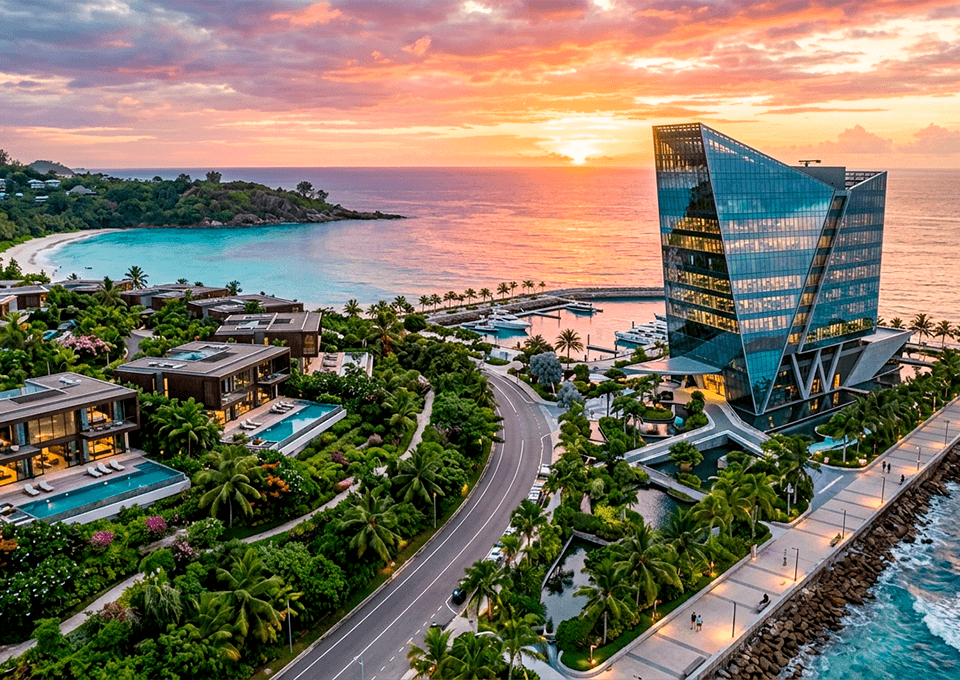
Real estate developments don’t emerge in isolation from their broader regional context. Trends unfolding across the Indian Ocean region, shifts in tourism patterns, evolving investor preferences, regional economic integration, and changing approaches to urban development all shape, directly or indirectly, the kinds of projects that make sense to build and when. Examining how these regional trends have influenced developments like Terre d’été and The Cube offers a useful lens into the broader forces shaping Mauritian real estate development.
Rising regional demand for quality residential product
Across the Indian Ocean region, rising incomes and increasing exposure to international residential standards, through travel, media, and growing cross-border investment, have gradually shifted buyer expectations upward. Residential developments that might have been considered premium a decade or two earlier no longer meet the expectations of an increasingly sophisticated buyer base, familiar with residential quality standards observed in more mature international markets. This shift has been reinforced by growing numbers of returning diaspora and internationally experienced buyers entering the domestic market, bringing with them direct, firsthand exposure to residential standards in more developed markets abroad.
Terre d’été’s emphasis on landscaped common areas, architectural coherence, and long-term livability reflects this broader regional trend toward more considered, quality-focused residential development. This isn’t a purely local design preference; it mirrors a shift observed across comparable island and coastal markets in the region, where developers have increasingly recognised that differentiation through genuine quality, rather than purely through price or location alone, is necessary to succeed in an increasingly competitive and sophisticated buyer market.
The regional shift toward mixed-use urban density
Land scarcity is not unique to Mauritius; it’s a shared characteristic across most Indian Ocean island economies, which has driven a broader regional trend toward mixed-use, higher-density development as a response to increasingly constrained and expensive land. This regional trend provided both a conceptual template and a degree of market validation for a project like The Cube, demonstrating that combining office, retail, and service functions within a single development could succeed in comparable island contexts facing similar land constraints.
Observing how mixed-use developments have performed in other regional markets, which combinations of functions have proven successful, and which configurations have struggled, provided valuable, if indirect, market intelligence that likely informed key design and tenant mix decisions for The Cube, reducing the risk associated with pursuing a genuinely novel development format in the Mauritian market for the first time.
Regional demographic shifts influencing long-term demand
Across the Indian Ocean region, demographic patterns, including migration flows between islands, the growth of a regionally mobile professional class, and shifting retirement and lifestyle relocation patterns among both regional and international populations, have gradually reshaped long-term real estate demand in ways that extend beyond purely local population growth within any single market. Mauritius has benefited particularly from its appeal to this regionally and internationally mobile population, supporting demand for both residential developments like Terre d’été, which appeal to longer-term relocations, and mixed-use commercial developments like The Cube, which serve the business activity this mobile population generates.
Cross-border capital flows and investor expectations
As capital increasingly flows across the Indian Ocean region, driven by Mauritius’s role as a regional financial hub and its network of investment-linked residency schemes, investor expectations have become correspondingly more internationalised. Investors evaluating opportunities in Mauritius increasingly benchmark against comparable projects and returns available elsewhere in the region and beyond, which places pressure on Mauritian developers to deliver projects that meet increasingly internationalised standards of design quality, financial structuring, and operational management.
This dynamic has likely influenced both Terre d’été’s emphasis on long-term value preservation (appealing to the more sophisticated, patient capital increasingly active in the region) and The Cube’s mixed-use design (reflecting an increasingly internationalised understanding of how modern urban development should function, rather than adhering purely to earlier, more localised development conventions).
Tourism recovery and diversification patterns
The tourism sector across the Indian Ocean region experienced significant disruption during the COVID-19 pandemic, followed by a recovery period that has, in many markets, been accompanied by a broader diversification away from pure dependence on traditional leisure tourism toward a more diverse mix of business travel, longer-stay residents, and lifestyle-driven relocations. This diversification trend has influenced real estate demand patterns across the region, supporting demand for developments that serve this broader, more diverse population beyond purely short-stay tourists.
Both Terre d’été, with its residential focus potentially appealing to longer-term residents and lifestyle relocations, and The Cube, with its mixed-use format serving both local business activity and broader commercial demand, reflect adaptation to this diversifying regional demand pattern, rather than continued reliance on a narrower, purely tourism-dependent demand base.
Climate resilience as an increasingly shared regional priority
Climate risk, cyclone exposure, coastal erosion, and broader concerns about long-term environmental resilience have become an increasingly shared priority across Indian Ocean island economies, driving convergence around more stringent construction standards and design approaches that prioritise resilience. This regional convergence has likely influenced construction and design standards applied to more recent developments like The Cube, reflecting broader regional trends toward climate-conscious development rather than purely locally-driven regulatory requirements.
Learning from failures as well as successes elsewhere in the region
Regional trends aren’t limited to successful models worth emulating; they also include cautionary examples of developments elsewhere in the region that failed to achieve their original ambitions, whether due to overly optimistic demand assumptions, poor execution, or a failure to adapt to shifting market conditions during a multi-year construction period. Observing and understanding these regional failures, not just regional successes, provides an equally valuable input into how developments like Terre d’été and The Cube were conceived, helping developers avoid repeating mistakes that have already played out visibly elsewhere in comparable markets. This kind of comparative learning, drawing lessons from both regional successes and regional cautionary tales, represents a genuinely underappreciated source of competitive advantage for developers willing to invest the time in tracking regional development patterns closely, rather than focusing narrowly on their own immediate domestic market alone.
The growing role of international design and engineering expertise
As Indian Ocean island economies have attracted increasing international investment, they have also attracted greater involvement from international architectural and engineering firms bringing global best practice to regional projects. This trend has gradually raised the baseline sophistication of design and engineering across the region, providing local developers like Apavou Group with access to expertise and design approaches that might not have been readily available domestically in earlier decades, further supporting the kind of ambitious, technically sophisticated projects that developments like The Cube represent.
Regional labour and construction capacity trends
Construction capacity, the availability of skilled labour, quality contractors, and specialised building expertise, has evolved across the Indian Ocean region in ways that have directly shaped what kinds of projects are feasible at any given point in time. As Mauritius’s own construction sector has matured, gaining experience with increasingly sophisticated project types, more ambitious developments like The Cube have become genuinely achievable in ways that might not have been true with the construction capacity available decades earlier.
This regional evolution in construction capacity has been gradual rather than sudden, but it represents an important, often underappreciated factor shaping the timing of when specific project types become viable; a mixed-use development of The Cube’s complexity requires a certain threshold of specialised construction and engineering expertise that takes time to develop within a local market, regardless of how strong the underlying demand signals might otherwise be.
Environmental and sustainability trends shaping regional development
Environmental consciousness has grown across the Indian Ocean region’s development community, partly in response to increasing awareness of climate vulnerability shared across these island economies, and partly reflecting broader global trends in sustainable construction practice reaching the region through international architectural and engineering firms increasingly active in regional projects. This shift has likely influenced material selection, energy efficiency considerations, and water management approaches incorporated into more recent developments across the region, including projects like The Cube, which would reasonably be expected to reflect more current sustainability thinking than developments completed a decade or more earlier.
Regional competition as a driver of continuous improvement
Finally, the increasing sophistication of real estate development across the broader Indian Ocean region has created a genuine competitive dynamic that pushes Mauritian developers toward continuous improvement, rather than allowing standards to remain static simply because a given approach previously proved successful. As comparable regional markets deliver increasingly sophisticated developments, Mauritian developers face growing pressure to match or exceed these standards to retain their position as the region’s most attractive destination for both capital and talent. This competitive pressure, while sometimes uncomfortable for established players, ultimately benefits the broader market by preventing complacency and encouraging continued innovation in design, construction quality, and operational sophistication across successive development cycles.
Conclusion
The rise of developments like Terre d’été and The Cube cannot be fully understood in isolation from the broader regional trends shaping Indian Ocean real estate development, rising residential quality expectations, land-driven density pressures, internationalising capital flows and investor expectations, evolving tourism and demographic patterns, and shared climate resilience priorities. Understanding these regional forces provides valuable context for why these specific developments took the form they did, and offers a useful framework for anticipating how future Mauritian developments might continue to evolve in step with broader regional trends.
 Previous Post