

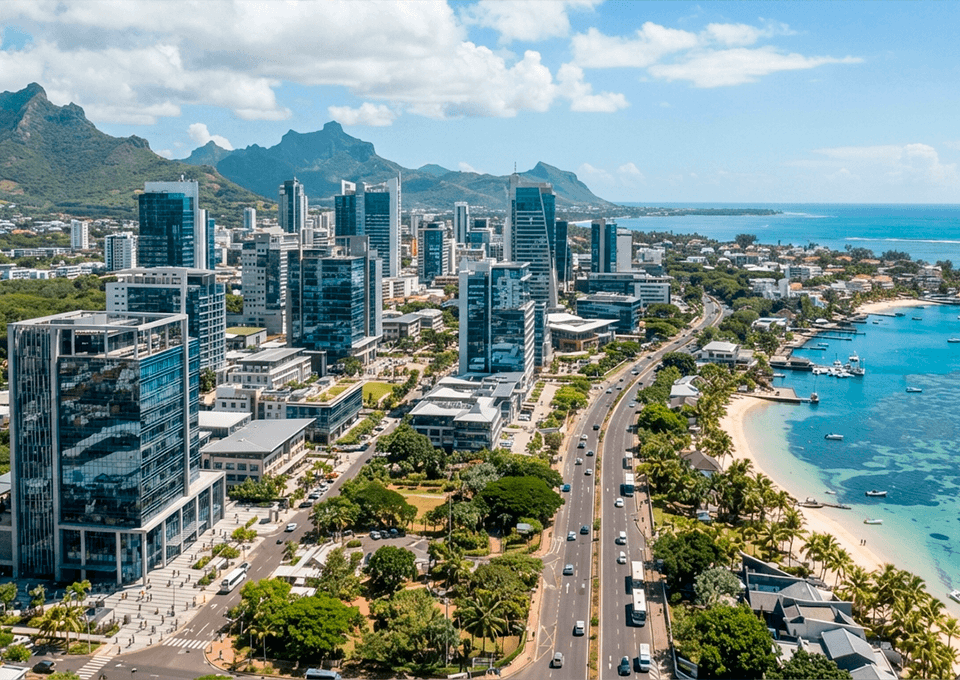
The Indian Ocean island economies, Mauritius, Réunion, Seychelles, Madagascar, and the Maldives, among others, share certain structural similarities while differing meaningfully in their specific economic composition, regulatory environments, and development trajectories. For a group with regional ambitions like Apavou Group, understanding why Mauritius specifically serves as the anchor of its broader Indian Ocean strategy requires examining what makes the Mauritian market distinctively suited to this role.
Political and regulatory stability as a foundation
Mauritius has maintained a notably stable political environment since independence, with peaceful democratic transitions of power and a consistent commitment to market-oriented economic policy across successive governments. This stability stands in contrast to more volatile political environments elsewhere in the region, and it provides a foundation of predictability that is particularly valuable for real estate investment, given the multi-decade time horizons involved in major development projects.
This stability extends to the regulatory environment governing property rights, foreign investment, and business operations more broadly. Mauritius’s well-established legal framework, combining French civil law heritage with English common law influences, provides a degree of legal predictability that is well understood by both regional and international investors, reducing the risk premium associated with committing significant capital to long-term projects in the market.
A market that rewards operators, not just capital
Mauritius’s relative maturity means that success in the market increasingly depends on genuine operational expertise, the ability to execute complex projects well, manage tenant relationships effectively, and navigate an increasingly sophisticated regulatory and competitive environment, rather than purely on access to capital alone. This shift toward an operator-driven market, rather than a purely capital-driven one, favours groups like Apavou Group that have built genuine operational depth over decades, relative to purely financial investors who might have access to comparable or greater capital resources but lack the accumulated operational capability that increasingly determines success in a maturing market like Mauritius.
A more developed financial and professional services ecosystem
Mauritius has developed a more sophisticated financial services sector than most of its regional neighbours, partly driven by its role as an international financial centre with an extensive network of tax treaties. This developed financial ecosystem extends benefits to the real estate sector specifically: a deeper pool of potential financing partners, more sophisticated legal and professional services capable of supporting complex transactions, and a construction sector that has grown in capability alongside the broader increase in development sophistication across the economy.
For a group considering where to anchor operations intended to eventually support activity across the broader region, this developed ecosystem represents a meaningful advantage; it’s considerably easier to access the professional services, financing relationships, and skilled labour required for sophisticated real estate development in Mauritius than in markets where this ecosystem remains less developed.
Strategic geographic positioning
Mauritius’s location places it at a genuinely strategic crossroads, accessible to African, Asian, and European markets, and positioned to serve as a natural hub for business activity spanning these regions. This positioning has historically supported Mauritius’s development as a preferred base for companies seeking to operate across the broader Indian Ocean and African region, which in turn supports real estate demand for office space, logistics facilities, and executive housing tied to this cross-regional business activity. This same connectivity advantage extends to direct flight access from major cities across three continents, a further structural advantage that reinforces Mauritius’s position as a natural regional hub relative to less connected alternatives elsewhere in the Indian Ocean.
For a real estate group, this strategic positioning translates into a broader and more diverse demand base than would be available in a market serving purely domestic needs, demand driven not just by Mauritius’s own population and economy, but by the broader regional business activity that increasingly chooses Mauritius as a base of operations.
Tourism infrastructure as a regional differentiator
Mauritius has developed tourism infrastructure, airport connectivity, hospitality sector sophistication, and destination marketing capability that exceeds most comparable Indian Ocean island economies. This infrastructure advantage supports not just the direct hospitality sector, but the broader real estate ecosystem that depends on sustained visitor flow, from retail centres benefiting from tourist spending to residential developments targeting the growing market of international buyers drawn to Mauritius through residency-linked investment programs.
This tourism infrastructure advantage took decades to build and represents a genuine barrier to competing destinations attempting to replicate Mauritius’s position quickly, providing a degree of durability to the demand base that supports Mauritian real estate more broadly.
Learning from, and informing, regional comparisons
Mauritius’s relative maturity within the regional context means that trends and lessons learned in the Mauritian market often provide useful, if imperfect, signals for how similar dynamics might eventually unfold in less mature regional markets. A group anchored in Mauritius, with deep operational experience in that market, is well positioned to apply these lessons should it choose to expand its activity into other Indian Ocean markets over time, bringing accumulated development, leasing, and management expertise honed in a more mature market to opportunities in markets still earlier in their own development trajectory.
This dynamic works in both directions: monitoring how comparable dynamics unfold in neighbouring markets also helps a Mauritius-anchored group anticipate shifts that might eventually reach its home market, given the structural similarities across these island economies; for instance, observing how other island destinations manage the tension between tourism development and environmental preservation can inform how similar tensions are likely to play out in the Mauritian context.
A base for serving international clients across the region
Mauritius’s role as an international financial centre means that many international businesses and investors already maintain a Mauritian presence for financial and legal structuring reasons, independent of any direct real estate interest. This existing international presence creates a natural, pre-existing client base for real estate services, office space, executive housing, and related commercial real estate that a Mauritius-anchored group is well positioned to serve, representing a demand source that doesn’t depend purely on organic growth in the domestic Mauritian economy or tourism sector alone. Serving this internationally-oriented client base also exposes a group to global standards and expectations around building quality, service delivery, and professional management practice, further reinforcing the broader sophistication advantage that a Mauritian base provides relative to less internationally connected regional alternatives.
Building institutional relationships that support regional expansion
A group anchored in Mauritius but considering broader regional engagement benefits from the relationships built with financing institutions, professional service providers, and regulatory bodies during its Mauritian operating history. These relationships, while specific to the Mauritian context, often provide useful introductions and credibility when a group begins exploring opportunities elsewhere in the region, since regional business networks, particularly within the financial services and real estate sectors, tend to be relatively interconnected across neighbouring island economies.
This relationship capital, built over years of consistent, reliable operation in Mauritius, represents a genuine asset that supports eventual regional expansion in ways that would be difficult for a group without an established Mauritian track record to replicate quickly, regardless of the capital resources available to a prospective new entrant to the region.
Talent development as a regional resource
Mauritius’s more developed professional services and construction sectors have also made it a source of trained talent, architects, engineers, project managers, and property management professionals, with skills transferable to comparable roles in neighbouring, less developed regional markets. A group with a substantial Mauritian operating history often develops internal talent that could, in principle, support expansion into other regional markets, providing an internal resource base that reduces dependence on recruiting unfamiliar talent in a new market from scratch.
Mauritius as a proving ground for regional strategy
Beyond its direct advantages, Mauritius functions as a genuine proving ground, a market mature and stable enough to allow a group to test and refine development approaches, tenant relationships, and operational practices with a manageable level of risk, before considering whether and how to adapt those same approaches to less mature, higher-risk regional markets. Strategies that succeed in Mauritius don’t necessarily transfer directly to other regional contexts without adaptation, but the disciplined process of developing, testing, and refining those strategies in a relatively stable home market provides a considerably stronger foundation for eventual regional expansion than attempting to develop entirely new approaches from scratch in an unfamiliar and potentially less stable market.
Currency and capital flow considerations
Mauritius’s currency stability and well-developed capital account framework, compared to some regional alternatives, reduces a layer of risk for both the group itself and the international investors and tenants it seeks to attract. This relative currency stability supports more predictable long-term financial planning for major development projects, whose returns are realised over many years and would otherwise be more significantly exposed to currency volatility in a less stable monetary environment.
Conclusion
Mauritius’s role as the anchor of Apavou Group’s Indian Ocean strategy reflects a combination of structural advantages, political and regulatory stability, a more developed financial and professional services ecosystem, strategic geographic positioning, mature tourism infrastructure, and relative currency stability that collectively make it a more favourable base for real estate development than most alternatives within the broader region. These advantages, built up over decades, provide a durable foundation that continues to support the market’s relative attractiveness even as neighbouring economies continue their own development trajectories.
 Previous Post
 Next Post